The ten new Revealer modules to try first are Apple (email), Vimeo, Ask Ubuntu, Infosec Exchange, OpenAI Community, Ko-fi, Untappd, AniList, itch.io and VK. All ten returned data on November 17, 2026. They are part of 420 modules added between October 8 and November 17, 2026: 359 for usernames, 52 for email addresses and 9 for phone numbers. For each pick we list the field names it returns, and for the nine username modules how long each took to answer. The full list of what changed is in the November 2026 module update.
The live catalog on November 17, 2026 lists 1,098 username modules, 263 email modules and 58 phone modules. In that window 420 modules were added and 22 retired, a net gain of 398. Nine of the ten picks are username modules. We checked each twice that day with the handle richard: once inside a full sweep of all 1,098 username modules, then again as a single lookup. The other pick, Apple, is an email registration check, and we tested it in two full email sweeps instead. We list field names only, never a value from any account. Run the same sweep yourself in username search.
How the ten were picked
Four tests, applied in order.
- New. The module was not in the catalog on October 8, 2026 and is in it on November 17, 2026.
- Well known. A service a general reader will recognize, or one with a clear audience such as developers, security staff or creators.
- Found in the full sweep. The module returned a found account for
richardduring the full username sweep on November 17, 2026. - Found again alone. The same module returned found again, with the same field set, in a separate single lookup that day.
One caution before the list. richard is a common handle. The full sweep on November 17, 2026 returned 675 found accounts for it, and those accounts belong to many different people, not one person. A found result shows that the module resolves that handle on that service. Tying an account to a specific person is separate work, and we cover it in how we verify a username match.
The ten at a glance: fields and response time
Times are from November 17, 2026. "Sweep" is the module's response time inside the full 1,098-module run. "Single" is the time when the module was looked up alone.
| # | Module | Search type | Fields returned | Sweep | Single |
|---|---|---|---|---|---|
| 1 | Apple | Existence only | Email sweep | n/a | |
| 2 | Vimeo | Username | Profile URL, account id, display name, bio, follower count, video count, creation date | 414 ms | 580 ms |
| 3 | Ask Ubuntu | Username | Profile URL, account id, display name, bio, location, avatar, website, creation date, last-active date | 575 ms | 2,650 ms |
| 4 | Infosec Exchange | Username | Profile URL, account id, avatar, banner, followers, following, creation date | 166 ms | 1,070 ms |
| 5 | OpenAI Community | Username | Profile URL, account id, display name, avatar | 453 ms | 680 ms |
| 6 | Ko-fi | Username | Profile URL, account id, display name, bio, avatar | 125 ms | 860 ms |
| 7 | Untappd | Username | Profile URL, account id, display name, bio, avatar | 764 ms | 1,060 ms |
| 8 | AniList | Username | Profile URL, account id, display name, bio, avatar, banner, post count, creation date | 1,081 ms | 5,810 ms |
| 9 | itch.io | Username | Profile URL, account id, display name | 2,472 ms | 2,160 ms |
| 10 | VK | Username | Profile URL, account id | 607 ms | 850 ms |
Apple is an email module. It ran inside the two full email sweeps, not the username sweep, so it has no per-module time in this table.
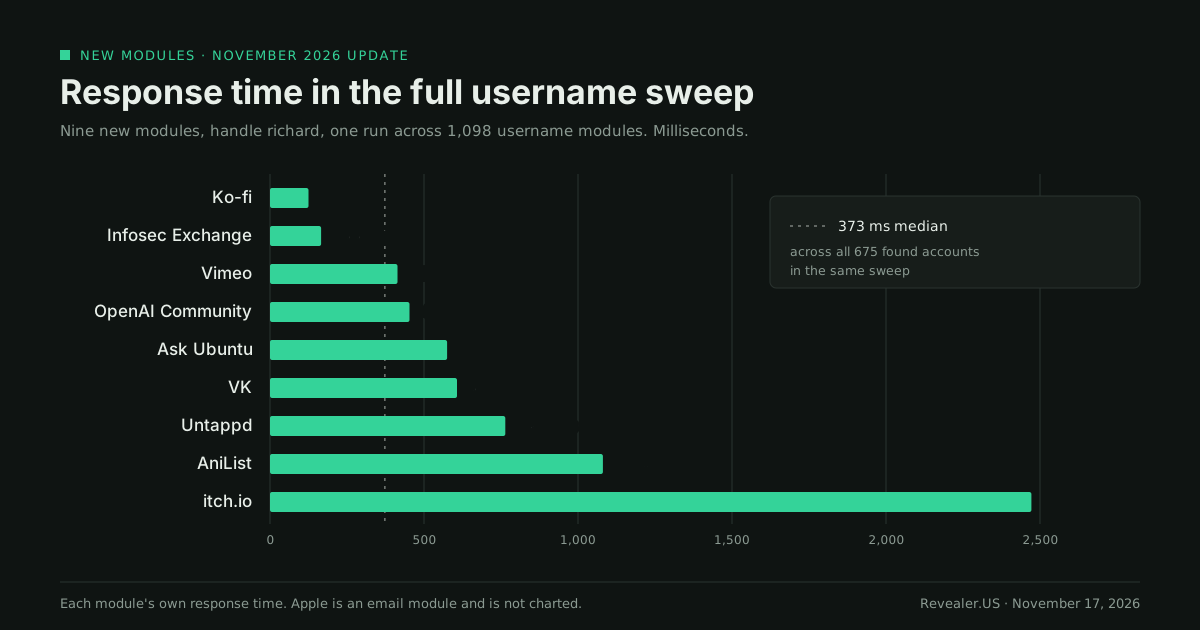
Six of the nine username picks answered in under 610 ms in the sweep. For context, the median response time across the 675 found accounts in that sweep was 373 ms. Full timings are in how fast a 1,098-module username search is.
The slowest, itch.io, took about 2.5 seconds. That does not hold anything up. Revealer streams each module's result as it finishes, so the fast answers are on screen while the slow ones are still working.
The top 10 new modules, one by one
1. Apple (email registration check)
Apple joined the email catalog in the November 2026 update. It is a registration check: it tells you whether an Apple account is registered to an email address. It returns existence only: registered or not. No name, no device list, no profile.
On November 17, 2026 we ran two full email sweeps across all 263 email modules, and the Apple module reported a registration in one of them. Apple also sits first in the popular-apps strip at the top of email results, so when it reports a registration you see it before anything else.
Why it leads this list: Apple is the first app in the popular-apps strip, and a registration hit tells you the address was used to open an account there. That is a starting point for an email investigation, not an identity. Run it from Revealer's email lookup, and see which apps an email is registered on for the rest of the strip.
2. Vimeo
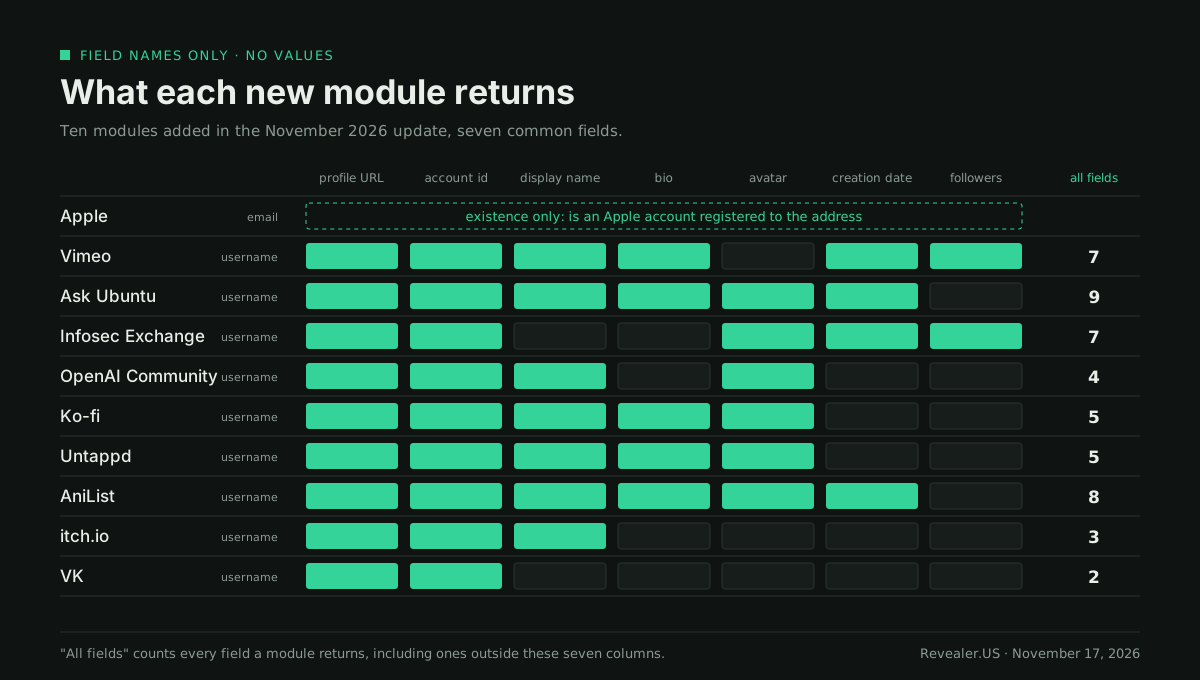
Vimeo returns seven fields, and the one that matters for a timeline is the creation date. Across the whole sweep, 41.3 percent of the 675 found accounts carried a creation date, so a module that supplies one is in the minority. Vimeo also returns a follower count and a video count.
3. Ask Ubuntu and the Stack Exchange family
Ask Ubuntu returns the widest field set of the ten: nine fields, including a creation date and a last-active date. Server Fault and Super User are new in the same update and return the same field set.
Software Engineering Stack Exchange and MathOverflow also arrived in this update and returned found for richard in the sweep. For a subject who works in IT or systems administration, this group gives you a creation date and a last-active date to place the account in time.
4. Infosec Exchange and mastodon.online
Infosec Exchange is a Mastodon server built around security topics. It returns seven fields, including follower and following counts and a creation date. It was the second fastest of the nine username picks at 166 ms in the sweep.
The new mastodon.online module returns the same field set. The update also added mastodon.art, mastodon.cloud, ruby.social, phpc.social and ohai.social, and all five returned found for richard in the sweep.
Mastodon handles are per server, so a Mastodon username search has to check servers one by one. Each server added to the catalog is one you no longer check by hand.
5. OpenAI Community and the developer-forum set
OpenAI Community returns profile URL, account id, display name and avatar. Hugging Face Forum, Cursor Forum and Unreal Engine Forum are new too and return the same four fields.
They are part of the largest single group in this update: 121 new forum modules, 91 of which returned a found account for richard on November 17, 2026. The list includes PyTorch Forums, GitLab Forum, HashiCorp Discuss, MongoDB Community, Obsidian Forum and the freeCodeCamp Forum. The whole group is covered in developer forums and the fediverse.
6. Ko-fi
Ko-fi was the fastest of the nine username picks: 125 ms in the sweep and 860 ms alone. It returns five fields, including a bio and an avatar. On a creator page the bio is the place to look for links to the creator's other accounts, which gives you the next handles to check.
7. Untappd
Untappd, the beer check-in app, is one of the hobby services added in this update. It returns a bio and an avatar you can compare against other profiles.
8. AniList
AniList took 1,081 ms in the sweep and 5,810 ms alone, the longest single lookup of the nine username picks. It is slower than the rest, and it gives you more: eight fields, including a creation date and a post count.
9. itch.io
itch.io is the only indie game marketplace among the ten. It returns profile URL, account id and display name. It took 2,472 ms in the sweep, the longest of the nine username picks, and 2,160 ms alone. If your subject builds indie games, check whether the itch.io handle matches the one on their code host.
10. VK
VK returns a profile URL and an account id. The account id is a reference you can record next to the URL. OK.ru was added in the same update and returned found for richard in the sweep.
Also new and working on November 17, 2026
These did not make the ten, but each one answered on November 17, 2026.
| Module | Search type | Fields returned | Sweep time |
|---|---|---|---|
| Farcaster | Username | Profile URL | 155 ms |
| komoot | Username | Profile URL, account id, display name, avatar, post count | 269 ms |
| Sleeper | Username | Profile URL, account id, display name, avatar | 55 ms |
| Stocktwits | Username | Profile URL, account id, display name | 156 ms |
| Whatnot | Username | Profile URL, display name | 578 ms |
| Redbubble | Username | Profile URL, display name, avatar | 2,113 ms |
| Python Discourse | Username | Profile URL, account id, display name, bio, location, avatar, creation date, last-active date, view count | 473 ms |
| Hack The Box Forum | Username | Profile URL, account id, avatar, creation date, last-active date, view count | 270 ms |
| Arduino | Username | Profile URL, account id, avatar, creation date, last-active date, view count | 174 ms |
| CVS | Existence check | Email sweep |
Farcaster was also confirmed a second time in a single lookup, in 380 ms. CVS is a new email existence check. It answered in both email sweeps on November 17, 2026.
How much the new modules add to one search
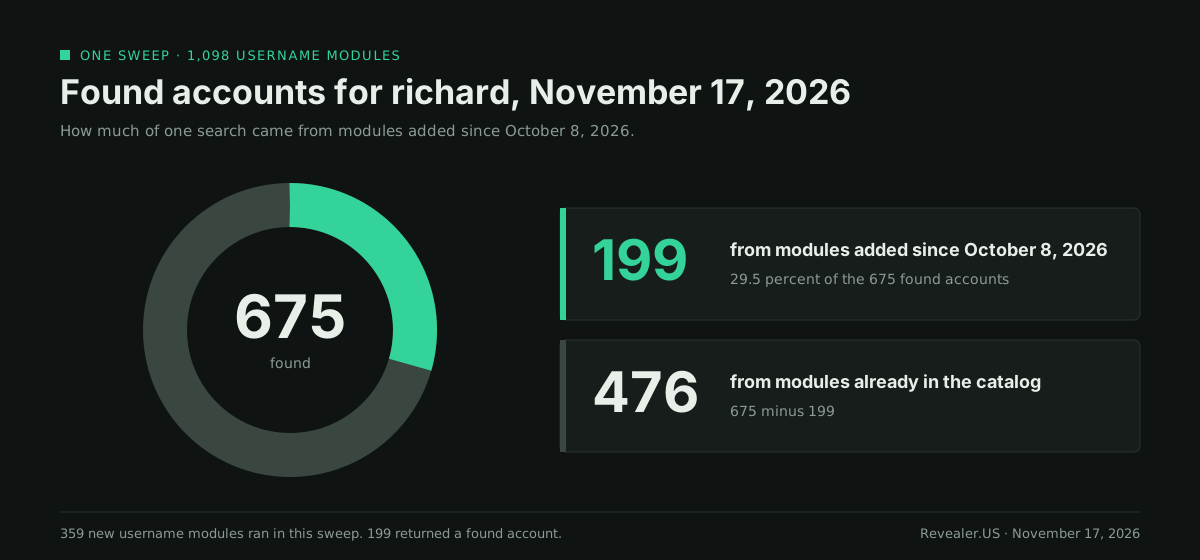
New modules supplied 199 of the 675 found accounts for richard on November 17, 2026, which is 29.5 percent. That count is measured against the October 8, 2026 catalog: every one of the 199 came from a module that did not exist in the catalog on that date.
How to use a hit from a new module
Treat every result as a lead, then do three things.
- Open the profile URL. Confirm the account exists and look at it on the service itself.
- Record the URL and the date. Profiles change and close. Your note should say what you saw and when. Revealer exports results as JSON or CSV if you want the full list in a file.
- Corroborate before you attribute. Look for a second signal specific to your subject, such as a link from a profile you have already confirmed.
Revealer fetches results live at search time from public sources and data partners. It does not own the underlying records. What a module can and cannot return is set out in what Revealer will and won't return. If your own handle or address shows up and you want it out of Revealer's results, the free opt-out suppresses it in our results. It does not delete anything at the source.
Which new module for which subject
| If your subject is | Start with | Why |
|---|---|---|
| A developer or systems administrator | Ask Ubuntu, Server Fault, Super User | Nine fields, including creation date and last-active date |
| In security | Infosec Exchange | Creation date and follower counts, 166 ms in the sweep |
| Active on AI or developer tool forums | OpenAI Community and the forum set | 121 new forum modules in the same sweep |
| A creator | Ko-fi or Vimeo | A bio on Ko-fi, a creation date on Vimeo |
| Known to you only by an email address | Apple | A registration check that runs in an email lookup |
The short version
Revealer added 420 modules between October 8 and November 17, 2026. Our ten to try first are Apple (email), Vimeo, Ask Ubuntu, Infosec Exchange, OpenAI Community, Ko-fi, Untappd, AniList, itch.io and VK. The nine username picks returned found for richard twice on November 17, 2026, and new modules supplied 199 of that sweep's 675 found accounts. You do not select modules. A username search runs the full username catalog and an email lookup runs the full email catalog, so the new username and email modules are included without setup. Free accounts get 10 social previews a day with no card, and paid plans on pricing start at $12.99 a month.
Revealer is not a consumer reporting agency. Its data may not be used for employment, tenant, credit, or insurance eligibility decisions.
Frequently asked questions
Do I have to select the new modules before I search? No. A username lookup runs the full live username catalog in one request, which was 1,098 modules on November 17, 2026. An email lookup runs the email catalog the same way. New modules join the sweep when they are added to the live catalog. No setting or selection is needed.
Can Revealer check whether an email address is registered with Apple? Yes. The Apple module added in the November 2026 update is a registration check for email addresses. On November 17, 2026 it reported a registration in one of our two full email sweeps. A hit is existence only: it says an Apple account is registered to the address and nothing more.
Does Revealer search Mastodon usernames?
Yes, server by server, for the servers in the catalog. The November 2026 update added new Mastodon server modules, including Infosec Exchange and mastodon.online. Seven of them returned found for richard on November 17, 2026: Infosec Exchange, mastodon.online, mastodon.art, mastodon.cloud, ruby.social, phpc.social and ohai.social.
Which of the ten new modules returns the most detail? Ask Ubuntu, with nine fields including creation date and last-active date. AniList is next with eight, then Vimeo and Infosec Exchange with seven each. VK returns two fields and Apple returns existence only.
Does a found result mean the account belongs to my subject? No. It means the handle exists on that service. Common handles belong to many different people. Open the profile, record the URL and date, and find a second signal before you attribute an account to anyone.