Law enforcement officers, licensed investigators, fraud teams and security analysts can use Revealer for public-source leads, under the same terms as every other user and within their own legal authority and agency policy. On November 17, 2026, Revealer's live catalog listed 1,098 username modules, 263 email modules and 58 phone modules. One username lookup runs the whole username catalog and streams each result as it finishes. Revealer supplies leads from public information. It is not a substitute for a warrant, subpoena or court order.
It does not give access to private messages or private account data either. Product facts in this post were checked against the live site and catalog on November 17, 2026.
Can law enforcement use Revealer?
Yes, and they already do. Police departments and other law enforcement agencies use Revealer today. We do not publish the names of the agencies we work with. Investigators and security teams use it to check where a username, email or phone number appears across public platforms, and any agency or unit can use it the same way, on the same plans.
There is one product and one set of terms. The safeguards described later in this post protect the people who appear in results, and they are part of every account.
What one lookup gives an investigator
Revealer is a search layer. It returns live results from public and connected sources at search time, and it does not own the underlying records. What you get is breadth, structure and speed in one place.
| Input | Modules in the live catalog on November 17, 2026 | What a result is |
|---|---|---|
| Username | 1,098 | A found account with platform name and profile URL, often with profile fields |
| Email address | 263 | A registration check: the service name and whether an account exists for the address |
| Phone number | 58 | Account checks and phone directory sources listed in the catalog |
The worked example. We ran one full username search for the handle richard on November 17, 2026. It returned 675 found accounts out of 1,098 modules checked. richard is a common handle, so those 675 accounts belong to many different people. Each hit is a lead to verify, not an answer.
What comes back with each hit. Every found result carries the platform name and a profile URL. Of the 675 found results, 591 (87.6 percent) carried at least one more profile field, and 452 (67.0 percent) carried three or more.
| Field | Results out of 675 | Share |
|---|---|---|
| Display name | 512 | 75.9 percent |
| Account id | 432 | 64.0 percent |
| Avatar image | 403 | 59.7 percent |
| Account creation date | 279 | 41.3 percent |
Creation dates help separate a long-standing account from one opened last week.
Speed of the first pass. Results stream. You start reading before the slowest source answers. In the richard sweep the median module response time was 352.5 milliseconds. Of the 675 found accounts, 549 came from modules that answered in under one second, and 630 from modules that answered in under two.
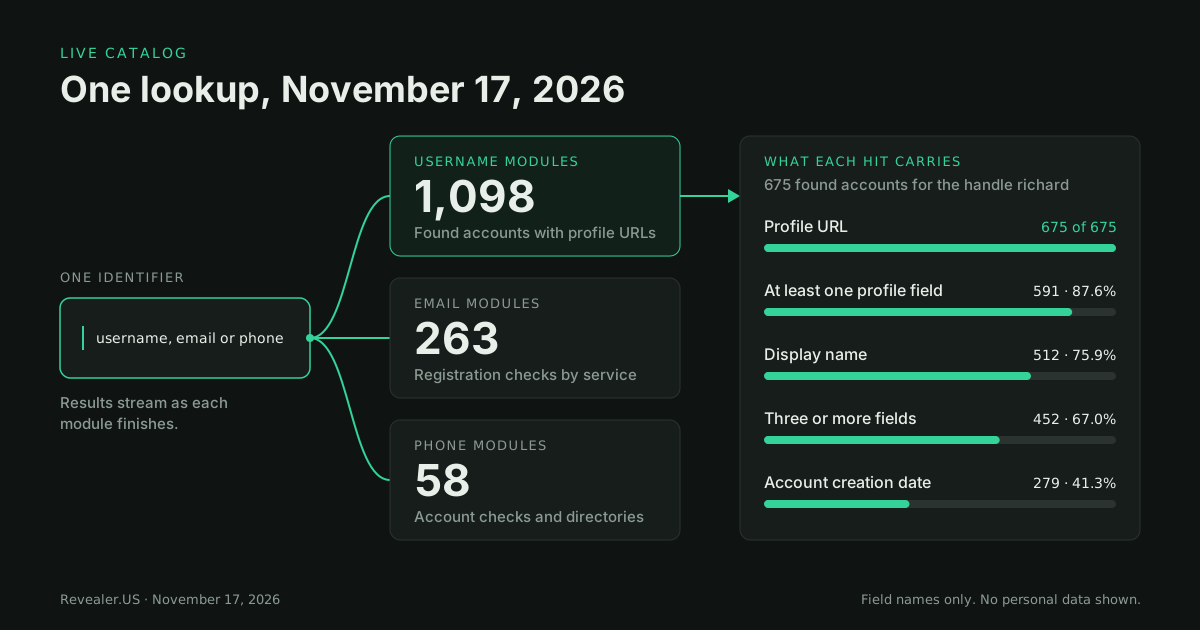
The email lookup and reverse phone lookup run against their own catalogs. Email results are mostly existence checks: they tell you which services have an account registered to the address.
Breach and stealer-log context, with passwords redacted
Fraud and cyber investigators often need to know whether an identifier has turned up in a breach or in infostealer logs. Revealer's data breach lookup is on every plan. Free accounts see previews. Stealer-log search with device exposures is included on Pro.
Revealer never shows you another person's password, on any plan. It shows that a password was exposed, not the password. The same redaction applies in the dashboard, in exports and in the API. An investigator learns which breach an address appeared in and what kind of data was exposed. Nobody walks away with a working credential for another person's account.
Working the results: export, monitoring, API and team seats
| Feature | What it does | Plan or location (November 17, 2026) |
|---|---|---|
| JSON and CSV export | Exports the results view, including breach and stealer-log sections, with credentials redacted | From the results view |
| Saved incidents | Saves findings and notes to your account until you delete them | In the dashboard |
| Breach monitoring | Watches identifiers for new exposure | 3 slots on Starter, 10 on Basic, 25 on Pro |
| API access | REST API with a Bearer key, 500 search requests a week, 3 whitelisted IPs | Pro |
| Team seats | Seats joined by invite, each seat with its own access and quota | Enterprise |
Exports are plain JSON and CSV working files. Record the date and URL of each finding yourself, and confirm it on the original platform. The platform is the source. Revealer is the pointer.
Enterprise is arranged with the Revealer team, not bought at checkout.
What Revealer is not
| Revealer is | Revealer is not |
|---|---|
| A fast first pass across public sources | A substitute for a warrant, subpoena or court order |
| A list of leads to verify at the source | Access to private messages, private accounts or subscriber records |
| A search layer over sources it does not own | A consumer reporting agency |
Results are leads. Our own Privacy Policy says a result "does not establish identity, account ownership, current compromise, or wrongdoing." A username match tells you an account with that handle exists. It does not tell you who is behind it. What Revealer will and won't return covers the sourcing limits in full.
No eligibility decisions. Results cannot be used for employment, tenancy, credit or insurance decisions.
The rules law enforcement agencies work under
Revealer's Acceptable Use Policy addresses law enforcement directly: "Law enforcement agencies must use the Service in accordance with applicable legal frameworks and constitutional protections. Warrants or subpoenas may be required for certain types of investigations." The policy also requires every user to have proper authorization and to keep records sufficient to show compliance.
That matches how the field already works. The points below are background from public sources, not legal advice. Follow your agency's policy and counsel.
Written policy on social media use
The Global Justice Information Sharing Initiative published guidance on social media policy in 2013 through the Bureau of Justice Assistance. It tells agencies what a written policy should cover: how they access, use, store and share information from social media sites, with a focus on privacy, civil rights and civil liberties.
What an agency may keep on file: 28 CFR 23.20
28 CFR 23.20 covers federally funded multi-jurisdiction criminal intelligence systems. A project may collect and maintain criminal intelligence information about an individual only where there is reasonable suspicion of involvement in criminal conduct and the information is relevant to it.
The same section bars collecting information about political, religious or social views, associations or activities unless it directly relates to criminal conduct. Seeing something in public does not mean an agency may file it.
What needs legal process: 18 U.S.C. 2703
Under the Stored Communications Act, 18 U.S.C. 2703, a governmental entity needs legal process to compel a provider to hand over non-public account data.
| Data sought from a provider | Process required |
|---|---|
| Contents in storage 180 days or less | Warrant |
| Non-content records | Warrant, court order or consent |
| Basic subscriber information | Subpoena |
OSINT covers what is publicly visible. Everything in that table is requested from the platform that holds it, not from a search tool.
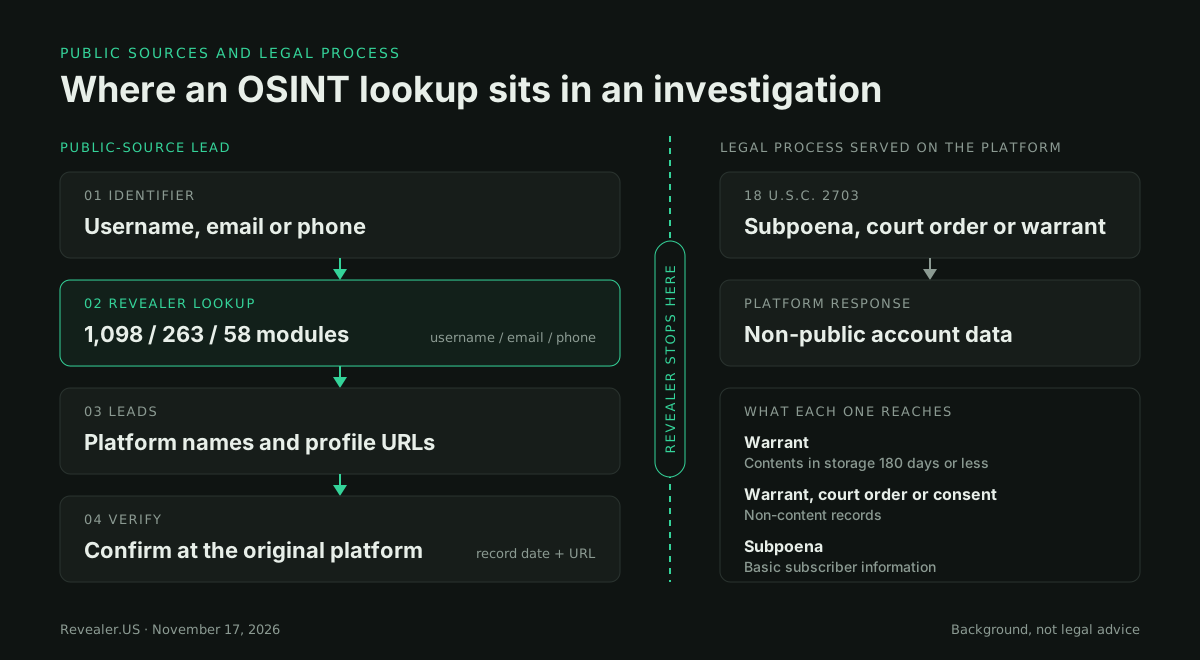
For the wider legal picture, see is OSINT legal. For the general method, see OSINT in 2026.
Safeguards that apply to every user
These safeguards protect the people who appear in results. All of them are live on November 17, 2026.
- Opt-out and suppression. Anyone can ask Revealer to suppress an email, username or phone number at opt-out, free and without an account. Suppression applies in Revealer's results and does not delete the record at its original source.
- Redacted secrets. Other people's captured passwords and hashes come back redacted in the dashboard, exports and API.
- Certification at signup. The signup form requires a certification that Revealer will not be used for decisions about employment, credit, housing, tenancy or insurance eligibility.
- State limits on people search. People search is not available for individuals located in California, Connecticut, Oregon, Texas and Vermont.
- Enforcement. Revealer may suspend accounts and report illegal use to authorities, and reports of policy violations are reviewed within 48 hours.
- Legal process. Revealer responds to valid, binding legal process, evaluates each request under applicable law, and may ask for clarification or challenge a demand where appropriate. When legally permitted, it makes reasonable efforts to notify affected users of requests for their account information.
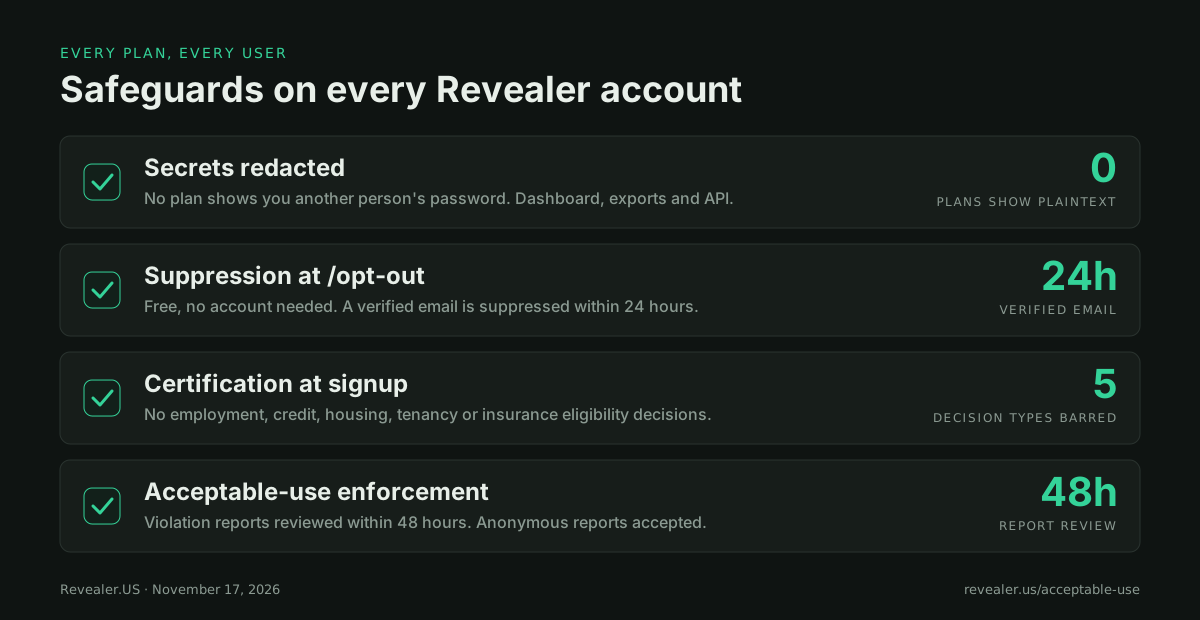
Each safeguard, with the page behind it, is covered in our post on opt-out, redacted passwords and use limits.
What Revealer costs a solo investigator or a small unit
Self-serve plans need no agency contract. You sign up, choose a plan and check out.
| Plan | Price on November 17, 2026 | Social lookups (username, email or phone) | Fit |
|---|---|---|---|
| Free | $0, no card | 10 previews a day | Trying the catalog on a known handle |
| Starter | $12.99/mo or $99/yr | 25 a day | A solo investigator with occasional lookups |
| Basic | $29.99/mo or $300/yr | 150 a day | Daily casework |
| Pro | $79.99/mo or $800/yr | 500 a day | Heavy casework that needs stealer-log search or the API |
| Enterprise | By arrangement | Custom per seat | A unit that needs team seats and custom volume |
Basic also includes unlimited breach lookups and AI Deep Search. A free Revealer account needs no card and includes 10 social previews, 10 breach previews and 50 people-search previews a day (checked November 17, 2026). Previews lock some fields.
Revealer's paid plans start at $12.99 a month. On November 17, 2026 that tied with Seer for the lowest entry price among the six tools we compared: Revealer, Seer, Fingerprint.to, UserSearch, OSINT Industries and Epieos (Epieos as published on epieos.com, archived copy of November 5, 2026). Current plan details are on pricing.
How to get in touch
Agencies and investigative teams reach Revealer through the contact page. Which topic to pick, what to put in a team request and what Enterprise includes are covered in how law enforcement and agencies contact Revealer.
If your unit only needs one or two accounts, open a free account, run a handle you already know, and judge the coverage yourself.
Revealer is not a consumer reporting agency. Its data may not be used for employment, tenant, credit, or insurance eligibility decisions.
The short version
On November 17, 2026, Revealer's live catalog listed 1,098 username, 263 email and 58 phone modules. One username lookup ran the whole username catalog and streamed results as they finished. The handle richard returned 675 found accounts, and 87.6 percent of them carried profile detail beyond a link. Breach and stealer-log context comes with secrets redacted, results export as JSON and CSV, and plans start at $12.99 a month with a free account and no procurement step. Revealer supplies the leads. Legal process and verification stay with the investigator.
Frequently asked questions
Can law enforcement agencies use Revealer? Yes. Police departments and other agencies use Revealer today, and we keep their names confidential. Officers and agency investigators sign up on the same plans and terms as everyone else and work within their own legal authority and agency policy. The live catalog listed 1,098 username, 263 email and 58 phone modules on November 17, 2026.
Does Revealer replace a warrant or subpoena? No. Revealer returns leads from public sources. Private messages, private accounts and subscriber records are held by the platform, and 18 U.S.C. 2703 sets the legal process a governmental entity needs to compel them.
Does a found account prove who owns it?
No. A hit shows that an account with that identifier exists on a platform. richard returned 675 found accounts on November 17, 2026, and they belong to many different people.
Can investigators see exposed passwords? No. Revealer never shows another person's password on any plan. You see that a password was exposed in a breach or a stealer log, and the value stays redacted in exports and the API too.
How much does Revealer cost for an investigator? Self-serve plans were $12.99, $29.99 and $79.99 a month on November 17, 2026, with a free account that needs no card. Enterprise, with team seats and custom volume, is arranged through the contact page.