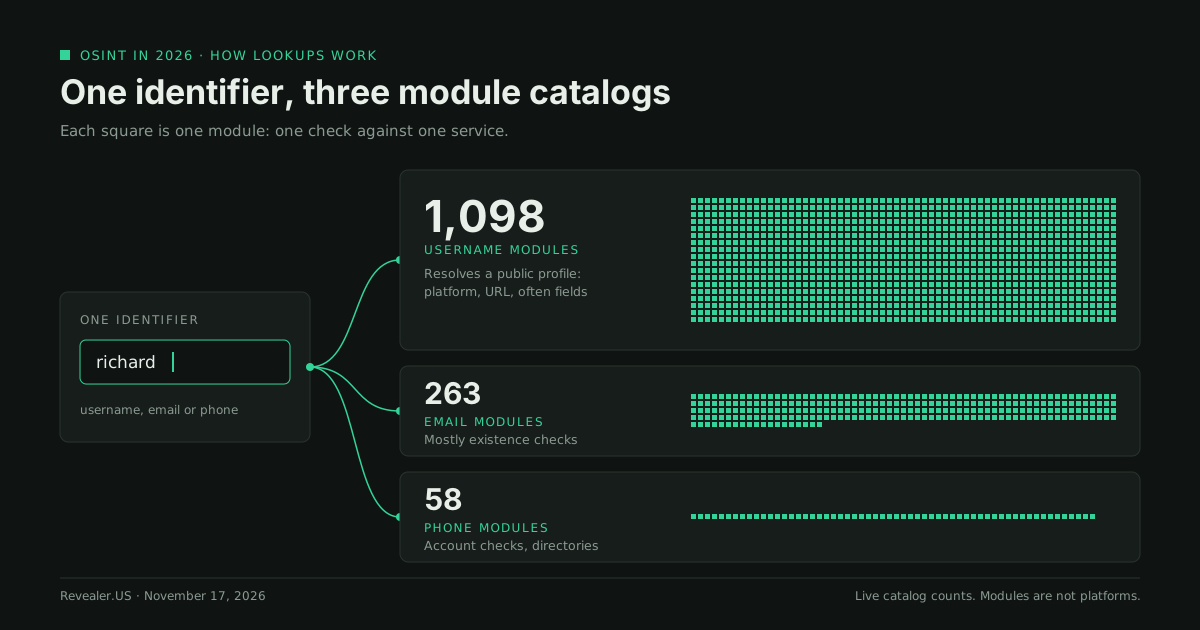
An OSINT lookup in 2026 takes one identifier, a username, an email address or a phone number, and checks it against a whole catalog of services at once. Each check is a module. On November 17, 2026, Revealer's live catalog listed 1,098 username modules, 263 email modules and 58 phone modules.
OSINT, short for open-source intelligence, is intelligence built from publicly available information. The US intelligence community's OSINT strategy for 2024 to 2026 describes it as intelligence derived exclusively from publicly or commercially available information that addresses specific intelligence priorities, requirements or gaps.
On November 17, 2026 we ran the handle richard through Revealer's username search. 675 of the 1,098 modules returned a found account. Results streamed in as each module finished, and every one of the 1,098 module results was delivered before the sweep's completion record. The timings are in how fast a 1,098-module search runs.
Revealer numbers below come from our own runs and catalog on that date. Figures for other tools come from each project's own pages on the same date. The public guidance cited is background, not legal advice, and none of those sources mention or approve any tool.
The three identifiers, and what a module is
A module is one check against one service. It takes an identifier and returns an answer about that service only. Modules are not the same thing as platforms: one brand can have several. The catalog holds four email modules and two phone modules for TikTok alone.
The three lookup types do different jobs.
| Lookup | Modules on November 17, 2026 | What the modules do | Examples from the catalog |
|---|---|---|---|
| Username | 1,098 | Resolve a public profile: platform name and profile URL, often with profile fields | Vimeo, Ask Ubuntu, Infosec Exchange, itch.io, VK |
| 263 | Mostly an existence check: an account is registered to the address on that service | Apple, Adobe, Dropbox, TikTok, Battle.net | |
| Phone | 58 | Account checks on major services, plus phone directories and caller-ID sites | Apple, Google, Microsoft, WhatsApp, Instagram, Airbnb |
Username modules resolve a profile
A username is public by design. The module finds the public page for that handle and reads what the page shows. Depth varies by service. The Vimeo module can return a profile URL, account id, display name, bio, follower count, video count and creation date. The Farcaster module returns a profile URL and nothing else. Both are hits. They are not the same kind of hit.
Email modules confirm a registration
Is an account registered to this address on this service? A hit contains the service name and the fact that the account exists. In one of our full email sweeps, 10 services returned a registration, and 2 of those 10 also carried public profile fields such as a display name. That is normal for email lookup: it maps where an address has accounts.
Phone modules are the newest catalog
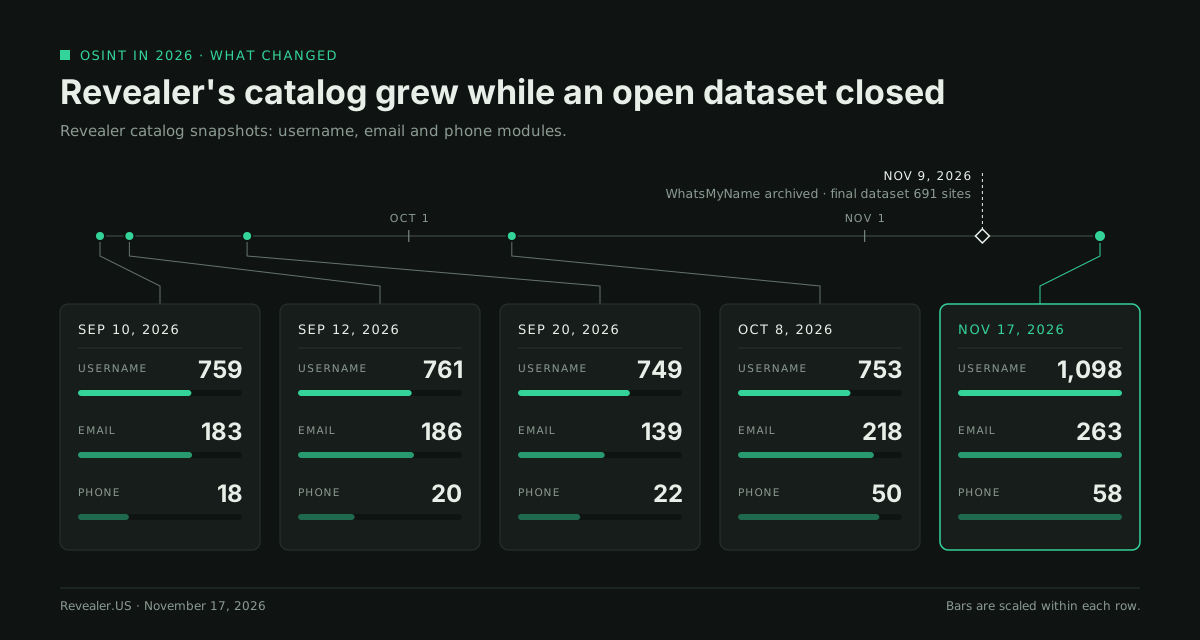
The catalog behind reverse phone lookup lists account checks for major services plus phone directories and caller-ID sites for the US, Canada and Europe. It is the smallest of the three catalogs, and it grew from 18 modules on September 10, 2026 to 58 on November 17, 2026.
What does a found result contain? Field coverage across 675 hits
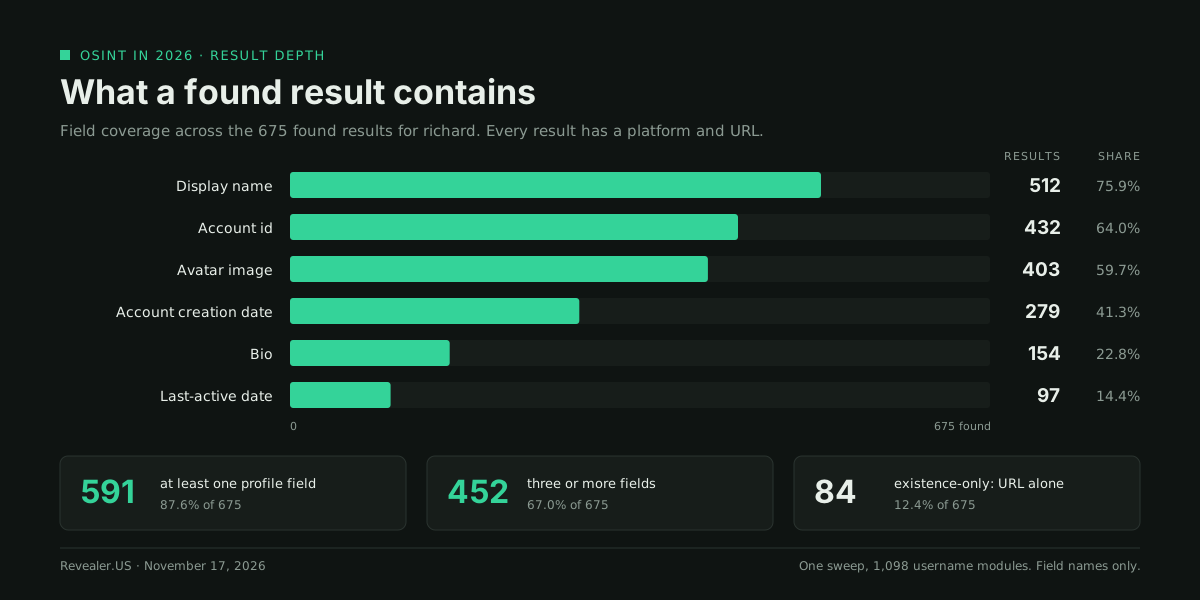
"675 found" says how wide a search went. It does not say how deep each result is. So we counted the fields across all 675 found results for richard.
Every found result carried the platform name and a profile URL. Beyond that:
| Field | Found results carrying it | Share of 675 |
|---|---|---|
| Display name | 512 | 75.9 percent |
| Account id | 432 | 64.0 percent |
| Avatar image | 403 | 59.7 percent |
| Account creation date | 279 | 41.3 percent |
| Bio | 154 | 22.8 percent |
| Last-active date | 97 | 14.4 percent |
591 of the 675 results (87.6 percent) carried at least one profile field beyond the URL. 452 (67.0 percent) carried three or more. 84 were existence-only: a URL and nothing else.
Read that as a statement about depth, not about a person. A creation date tells you how old an account is, and a last-active date tells you whether it is still in use. Those two fields help most when you sort a long list.
What changed in OSINT tooling in 2026
Revealer's username catalog grew 45.8 percent in under six weeks. It went from 753 modules on October 8, 2026 to 1,098 on November 17, 2026, which is 345 more. The counts on the site update as modules are added.
A widely used open dataset was archived. WhatsMyName is a community dataset of username checks that other tools read. Blackbird's README, for one, says its username checks are integrated with it. The project started in 2015, and its maintainer archived it on November 9, 2026 with a final dataset of 691 websites.
The README gives the reasons plainly: maintaining hundreds of site detections was more than a few volunteers could sustain, and newer username tools now solve the problem the project was built for. The data files stay online, but the README warns that the data "will get less accurate over time".
The other open-source projects, by their own repositories on November 17, 2026:
- Maigret is active. Its last commit was November 13, 2026 and its latest release, v0.6.6, shipped September 18, 2026.
- Blackbird had its last commit on November 3, 2026.
- Holehe, an open-source email registration checker, had its last commit on September 10, 2024. Its latest PyPI release is dated July 21, 2022.
Open-source OSINT tools vs hosted search in 2026
Open-source command-line tools are free and run on your own machine. Hosted search runs in a browser with nothing to install. The counts below are each project's own published figures in its own unit. A site, a module and a platform are not the same unit, so this is not a ranking.
| Tool | Type | Inputs | Published count, its own unit | Cost | Last code activity |
|---|---|---|---|---|---|
| Revealer | Hosted search | Username, email, phone, breach; stealer logs on Pro | 1,098 username, 263 email, 58 phone modules | Free previews; paid plans from $12.99 a month | Catalog dated November 17, 2026 |
| WhatsMyName | Open dataset, third-party web front end | Username | 691 sites (final dataset) | Free | Archived November 9, 2026 |
| Maigret | Open-source CLI, install | Username | 5,900 sites (README); 9,535 (its sites list, November 13, 2026) | Free, MIT license | Commit November 13, 2026 |
| Holehe | Open-source CLI, install | 121 modules listed in its README | Free, GPL-3.0 | Commit September 10, 2024 | |
| Blackbird | Open-source CLI, install | Username, email | More than 600 platforms, per its README | Free | Commit November 3, 2026 |
Revealer's lead is breadth in one place. By each project's own published pages on November 17, 2026, Revealer is the only tool in this table that lists phone number search, and the only one that lists breach and stealer-log search. Username, email, phone and breach search sit in one hosted account, with stealer-log search on Pro and results that stream as modules finish.
On module counts, Revealer's 1,098 username modules outnumber the 691 sites in WhatsMyName's final dataset, and its 263 email modules outnumber the 121 in Holehe's README (different units, as noted above).
The open-source tools are free, and both of Maigret's published site counts are larger than Revealer's username module count. If you want the largest published site list on your own machine, Maigret is the one to install. Its README says a default run checks the 500 highest-ranked sites and a flag scans the full list.
Pick by the job:
| Your job | Use | Why |
|---|---|---|
| Username, email and phone in one hosted search | Revealer | 1,098 / 263 / 58 modules on November 17, 2026, nothing to install |
| Check your own exposure across accounts and breaches | Revealer | Account discovery plus breach search in one account, with stealer-log search on Pro |
| Username-only sweep on your own machine | Maigret | Largest published site list here (full list needs its all-sites flag), free, MIT license |
| Script a quick email registration check | Holehe | Free CLI with CSV output; note the 2024 last-commit date |
| Learn how username checks are built | WhatsMyName dataset | Open data, free to download, archived November 9, 2026 |
What OSINT cannot reach: private account data
OSINT covers what is publicly visible. It does not cover what a platform holds privately about an account.
Public guidance draws that line clearly. Under the Stored Communications Act, 18 U.S.C. 2703, a government body that wants non-public account data must serve legal process on the provider that holds it: a warrant for recent message contents, a warrant or court order for other account records, a subpoena for basic subscriber information.
No lookup tool changes that. Revealer is a starting point for leads from public sources. It is not a substitute for a warrant, subpoena or court order, and it does not give access to private messages or private account data. For the wider legal background, see is OSINT legal.
Six rules for using lookup results responsibly
These rules are drawn from two public sources. The DOJ-backed 2013 guidance on social media in investigations expects a written policy, a valid purpose, authorization and documentation. The Berkeley Protocol treats collection, preservation, verification and analysis as separate stages. Follow your own organization's policy and counsel where they say more. For a full investigation workflow, see our step-by-step OSINT investigation guide.
- Write down your purpose and your authorization. One sentence each. If you cannot say why you are searching and who allowed it, stop there. Revealer's acceptable-use rules require proper authorization before researching individuals or organizations.
- Start from your own exposure or an authorized scope. Your own handles, your own addresses, your organization's domain, or a scope a client or agency has approved in writing.
- Record the date and the URL of every finding. Public pages change. A finding without a date and a source cannot be checked later.
- Confirm on the original platform. Open the profile URL. Check that the page exists and shows what the result says.
- Corroborate before you rely on it. One match is one data point. Look for a second, separate signal, such as a linked account or a matching creation period, before you connect two accounts.
- Keep results out of eligibility decisions. The Fair Credit Reporting Act limits consumer reports to listed permissible purposes such as credit, employment, insurance and tenancy. Revealer is not a consumer reporting agency, and its results may not be used for those decisions.
A hit is a lead, not an identity
richard returned 675 found accounts. Those are not 675 accounts of one person. A common handle belongs to many different people, and a found result proves only that the handle resolves on that platform.
A match does not establish who owns an account, and it does not establish wrongdoing. Treat each hit as a place to look, then apply rules 4 and 5.
Breach and stealer-log context, without the secrets
Exposure checks answer a different question from account discovery: has this identifier appeared in breach data or in stealer logs? A data breach lookup shows that an exposure happened and that a password or other secret was part of it. It does not show the secret. No Revealer plan shows plaintext passwords. Secrets are redacted in results and in JSON and CSV exports.
That is enough to act on. If your address appears, change that password everywhere it was reused.
Anyone can ask Revealer to suppress an identifier from its results at opt-out, free and without an account. Suppression applies in Revealer's results. Revealer does not own the underlying records and cannot delete them at the original source. The full list is in Revealer's responsible-use safeguards.
The short version
On November 17, 2026 Revealer's catalog held 1,098 username, 263 email and 58 phone modules, and richard returned 675 found accounts, 87.6 percent of them with profile detail beyond a link. Username modules resolve profiles. Email modules mostly confirm that an account exists. The phone catalog lists account checks and phone directories. Of the five tools in our table, Revealer is the only one that lists phone, breach and stealer-log search. Run your own handle through username search. Free accounts get 10 social previews a day with no card, and paid plans start at $12.99 a month on pricing.
Frequently asked questions
How do OSINT lookups work in 2026? One username, email address or phone number is checked against a hosted catalog of modules, and each module checks one service. A username module returns the platform name and profile URL, often with profile fields. Revealer's catalog listed 1,098 username, 263 email and 58 phone modules on November 17, 2026.
What does an email lookup show? Mostly whether an account is registered to that address on each service. In one full email sweep on November 17, 2026, 10 services returned a registration and 2 of those also carried public profile fields. It does not show passwords or private account data.
Is WhatsMyName still maintained? No. Its maintainer archived the project on November 9, 2026 with a final dataset of 691 websites. The data files remain online and free, but the README says nobody is updating the detections, so results should be verified.
Does a username match prove who owns an account? No. A found result proves the handle resolves on that platform. Common handles belong to many people. Confirm on the original platform and corroborate with a second signal before you connect accounts.
Can I use Revealer results for hiring or tenant screening? No. Revealer is not a consumer reporting agency, and its results may not be used for employment, tenant, credit or insurance eligibility decisions. It is for checking your own exposure and for lawful, authorized investigation.
Revealer is not a consumer reporting agency. Its data may not be used for employment, tenant, credit, or insurance eligibility decisions.