Is Revealer safe to use? Yes, and the rules are public. On November 17, 2026, anyone can opt out for free without an account, and a verified email address leaves Revealer results within 24 hours. No plan shows anyone else's plaintext passwords, in the dashboard, in exports or in the API. Results are fetched live at search time, and Revealer does not keep a saved copy of them. Revealer is not a consumer reporting agency, and its Acceptable Use Policy commits to reviewing misuse reports within 48 hours.
The signup form requires a certification that results will not be used for employment, credit, housing, tenancy or insurance decisions. The Acceptable Use Policy sets out consequences from a warning to permanent termination, and Revealer responds to valid, binding legal process.
Everything below was checked against the live opt-out page, Acceptable Use Policy, Terms of Service and Privacy Policy on November 17, 2026. Below is each safeguard, with the page that backs it.
Is Revealer safe? The safeguards at a glance
Yes. Revealer publishes its rules, and each safeguard below maps to a public page you can read before signing up. Eleven safeguards, checked on November 17, 2026.
| Safeguard | What it means for you | Where it is written |
|---|---|---|
| Free opt-out, no account | Ask for your identifier to be suppressed from Revealer results at no cost | /opt-out |
| Verified email suppressed automatically | Out of results within 24 hours of confirming the address | /opt-out |
| Other identifiers reviewed by a person | Usernames, phone numbers, names and addresses, typically within 4 weeks | /opt-out |
| Passwords redacted | No plan shows anyone else's plaintext passwords | /docs |
| Live results | Fetched at search time, no saved copy of results kept | /opt-out, /terms |
| Not a consumer reporting agency | No employment, tenant, credit or insurance eligibility use | /terms, /acceptable-use |
| Signup certification | The signup form requires you to accept the eligibility rule before you can create an account | /signup |
| Adults only | Accounts are for people 18 and older | /terms |
| State limits on people search | Not available for individuals located in five states | /terms |
| Written consequences | Warning through permanent termination; the policy says reports are reviewed within 48 hours | /acceptable-use |
| Legal requests | Evaluated under applicable law; Revealer responds to valid, binding legal process | /privacy |
How do I opt out of Revealer?
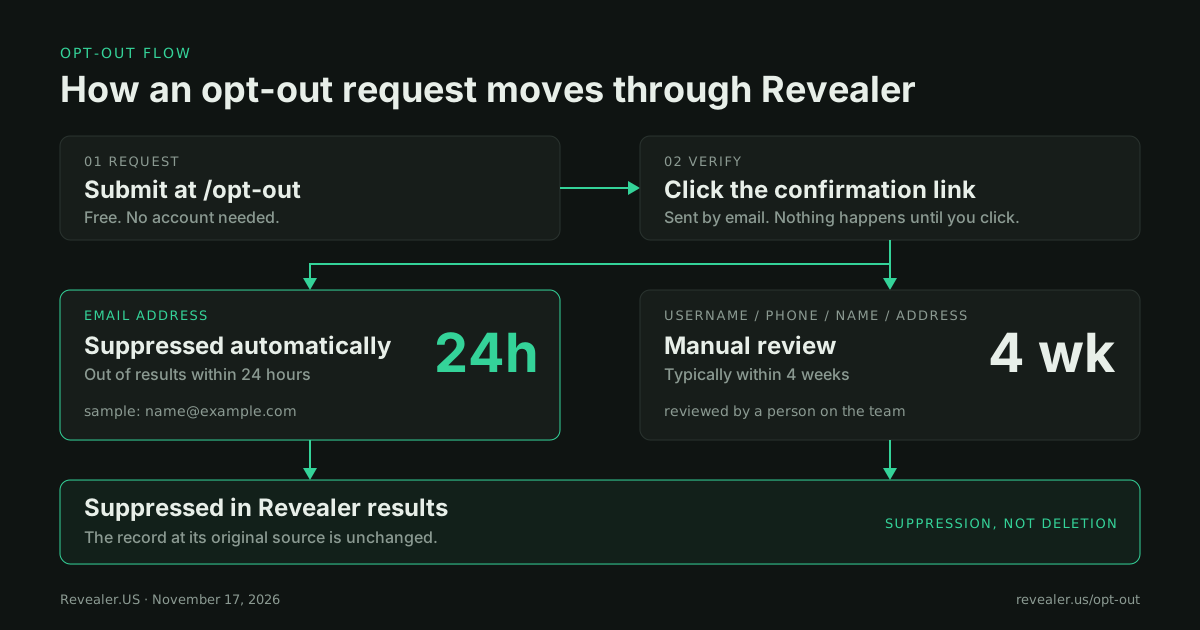
Go to the opt-out page, choose the type of identifier, enter the value and submit. The request is free and you do not need an account. Every request starts with a confirmation link sent by email, and nothing happens until you click it. For an email address, the link proves you control the address. For other identifiers, it confirms a reachable contact before a person on the team reviews the request.
What happens next depends on the identifier.
| Identifier | How it is verified | What happens | Timing stated on the page |
|---|---|---|---|
| Email address | Confirmation link sent to the address being suppressed | Suppressed automatically | Out of results within 24 hours |
| Username | Confirmation link to your contact email, then manual review | Suppressed after review, for the platforms you pick or for all platforms | Typically within 4 weeks |
| Phone number | Confirmation link to your contact email, then manual review | Suppressed after review | Typically within 4 weeks |
| Full name or home address | Confirmation link to your contact email, then manual review | Suppressed after review | Typically within 4 weeks |
Why email is fastest. Clicking a link sent to [email protected] shows you control that address, so no person needs to look at it and the suppression is automatic. A username or a phone number cannot prove itself the same way, so a person on the team reviews those requests.
It covers every search type. Once an identifier is suppressed, the check applies across username, email and phone lookups, breach search, device-exposure search and people search. It applies to every user on every plan.
What opting out does not do: suppression, not deletion at the source
This is the limit, and the opt-out page states it too. Revealer is a search layer over public and third-party sources that it does not own or control. It cannot erase a record held by a platform, a public office or a breach archive. A successful request suppresses your identifier so it no longer returns results in Revealer. The record at its original source is untouched.
Two practical consequences follow.
First, Revealer has to keep the suppressed identifier itself. That is how it knows what to keep out of results.
Second, suppression in Revealer does not reach other sites. If your goal is a smaller footprint everywhere, work through the sources one at a time. Our guide to removing yourself from people-search sites covers that process, and it is slower than a single form.
Does Revealer show passwords?
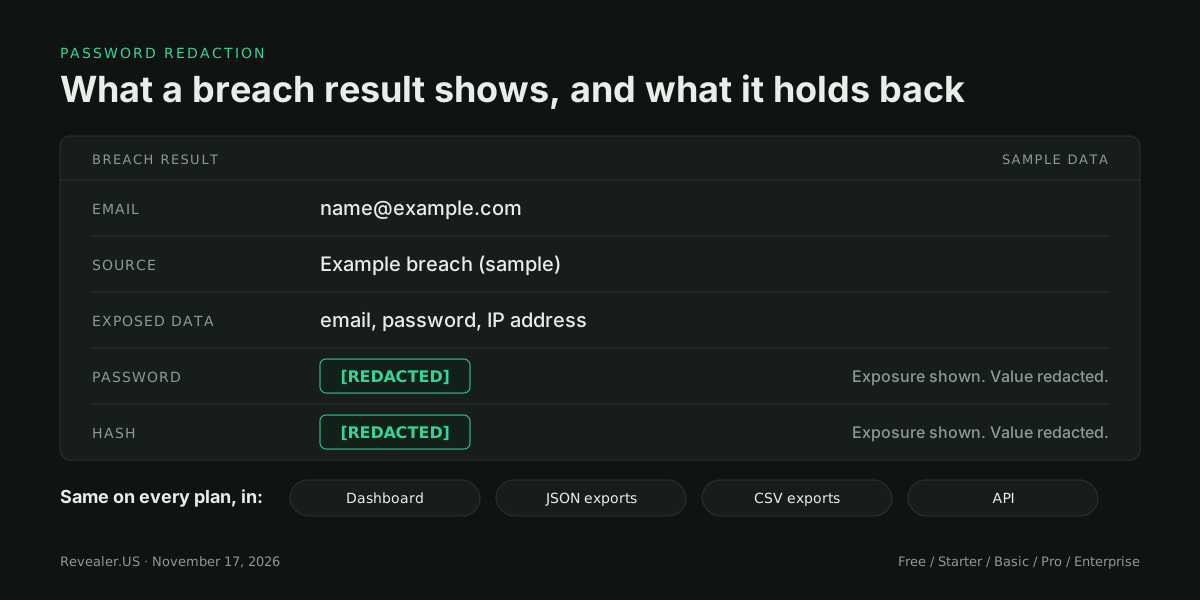
No. Revealer shows that a password was exposed, in which breach, and what other kinds of data sat beside it. Another person's password value comes back as [REDACTED].
That holds in three places:
- Dashboard. Breach results show the exposure with the secret masked on Free, Starter, Basic, Pro and Enterprise. Stealer-log results, on the plans that include them, are masked the same way.
- Exports. JSON and CSV exports redact password, hash, token, cookie and key fields before the file is written.
- API. The public API docs state that credentials are returned as the literal string
[REDACTED].
A defender needs to know that a credential leaked so the password can be changed and sessions revoked. Nobody doing that job needs another person's working password. A higher plan buys more lookups and more features. It does not buy the secrets.
For the wider picture of what a result contains and what is held back by source type, see what Revealer will and won't return.
Does Revealer store search results?
Results are fetched live at search time. Revealer does not keep a copy of search results as a saved history. It keeps your account details, billing and usage records, and what you explicitly save, such as a saved incident. The Privacy Policy lists every category of record that is kept and why.
This is the same reason opt-out works as suppression: there is no stored copy of results to delete.
What can you use Revealer for, and what is prohibited?
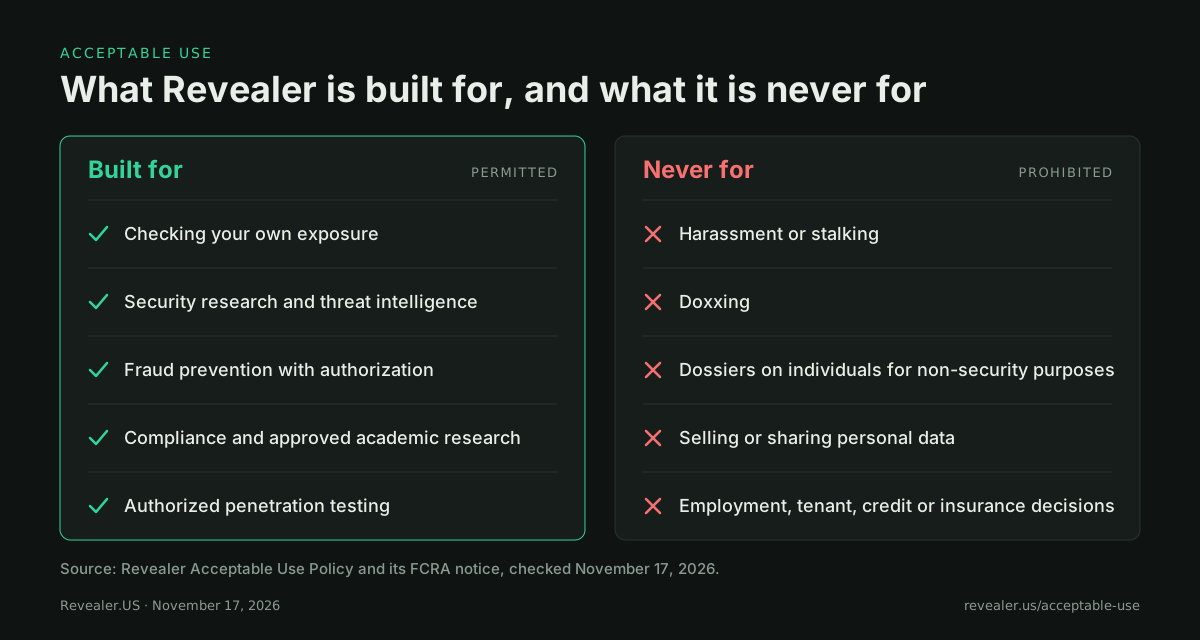
The Acceptable Use Policy lists permitted and prohibited uses by name. The short form:
| Permitted | Prohibited |
|---|---|
| Checking your own data exposure and credential compromises | Harassing, threatening or intimidating anyone |
| Security research on threats to your organization | Stalking or tracking a person without their knowledge or consent |
| Threat intelligence | Doxxing or publishing private information without consent |
| Fraud prevention with proper authorization | Building dossiers on individuals for non-security purposes |
| Due diligence, excluding any FCRA-regulated purpose | Selling or sharing personal data obtained through the service |
| Compliance and approved academic research | Identity theft, fraud, blackmail or unauthorized account access |
| Penetration testing with explicit written authorization | Activities involving minors or exploitation |
Four more limits sit in the Terms and the signup form.
No FCRA decisions. Revealer is not a consumer reporting agency. The signup form will not submit until you tick a box that reads: "I certify I will not use Revealer for decisions about employment, credit, housing, tenancy, or insurance eligibility (FCRA-covered purposes)." For those decisions, use a screening service that operates under the Fair Credit Reporting Act.
Authorization comes first. The policy requires proper authorization before researching individuals or organizations, including any permission, warrant or consent the law requires. Our explainer on whether OSINT is legal covers where those lines sit.
Adults only. Accounts are for people 18 and older.
State limits on people search. People search is not available for individuals located in California, Connecticut, Oregon, Texas and Vermont.
What happens if someone misuses Revealer?
The Acceptable Use Policy lists the consequences in order: a warning and a request to correct the behavior, temporary suspension, permanent termination without refund, reporting to law enforcement authorities, civil action and referral for criminal prosecution. The policy reserves the right to monitor for violations and to investigate suspected ones.
If you believe an account is misusing Revealer, report it. The policy page lists the contact, and the contact form reaches the team as well. The policy says reports of violations will be reviewed within 48 hours, and anonymous reports are accepted. An account holder who disagrees with an enforcement action can appeal within 30 days.
Does Revealer respond to legal requests?
Yes. The Privacy Policy says requests from law enforcement and other authorities are evaluated under applicable law, and that Revealer responds to valid, binding legal process and may ask for clarification, object or challenge a demand where appropriate. The request route is covered in how agencies can contact Revealer.
An agency or investigator who opens an account does so under the same terms as every other account. The Acceptable Use Policy says law enforcement use must follow applicable legal frameworks and constitutional protections. Our post on Revealer for law enforcement and investigators covers lawful use in more detail.
How do I check and reduce my own exposure?
The safeguards above are Revealer's side. These are yours.
| Step | What it does | Where |
|---|---|---|
| Turn on two-factor authentication | Adds a second check at sign-in | Account settings |
| Run your own identifiers first | Shows what a search on your email, username or phone returns | Username search, data breach lookup |
| Set breach monitoring | Watches your identifiers for new exposure: 3 slots on Starter, 10 on Basic, 25 on Pro | Pricing |
| Opt out what you do not want returned | Suppresses the identifier in Revealer results | /opt-out |
A free account is enough to start. On November 17, 2026 it includes 10 social previews and 10 breach previews a day, with no card. If a breach lookup shows an exposed password, change it everywhere it was reused, then follow the steps in how to check if your email is in a data breach.
Revealer is not a consumer reporting agency. Its data may not be used for employment, tenant, credit, or insurance eligibility decisions.
The short version
Opt-out is free and needs no account. A verified email address is out of Revealer results within 24 hours. Usernames, phone numbers, names and addresses go to manual review, typically within 4 weeks. It is suppression in Revealer, and the record at its source stays where it is. No plan shows anyone else's plaintext passwords, and results are fetched live with no saved copy kept. Reports of misuse are reviewed within 48 hours under the Acceptable Use Policy, and a violation can end an account. To remove an identifier, start at the opt-out page. To see what a search on you returns, start with username search.
Frequently asked questions
How long does a username or phone number opt-out take? After you confirm the request by email, a person on the team reviews it. The opt-out page says this is typically completed within 4 weeks. Username requests can cover specific platforms or all platforms.
Does opting out delete my information? No. Revealer searches sources it does not own or control, so it cannot delete the records they hold. Opting out suppresses your identifier so it no longer returns results in Revealer. The original source is unchanged, and other sites need their own requests.
Can a paid plan see other people's passwords?
No. Another person's passwords and hashes come back as [REDACTED] on every plan, in the dashboard, in JSON and CSV exports and in the API. Revealer shows that a password was exposed, not the password.
Can I use Revealer to screen a tenant or a job applicant? No. Revealer is not a consumer reporting agency, the signup form requires a certification against those uses, and the Terms prohibit them for every account. Use a screening service that operates under the Fair Credit Reporting Act.
How do I report someone misusing Revealer? Use the contact listed on the Acceptable Use Policy page or the contact form. The policy says reports of violations will be reviewed within 48 hours, and anonymous reports are accepted. Listed consequences range from a warning to permanent termination and reporting to authorities.