On November 17, 2026 we ran the handle richard through all 1,098 username modules in Revealer's live catalog and recorded how long every module took to answer. Half of them answered in about a third of a second: the median was 352.5 ms. 851 of the 1,098 answered within one second.
Results stream as each module finishes. Of the 675 accounts found, 549 came from modules that answered in under a second. The sweep finished its 1,098 modules in 55.3 seconds of execution time.
The catalog grew from 753 username modules on October 8, 2026 to 1,098 on November 17, 2026, as covered in the November 2026 module update. The numbers below show what that breadth costs in time for the typical module: very little. Every figure comes from one dated run, and the distribution is printed so you can check the claim against the table instead of taking a single headline number on trust.
What we measured, and what we did not
One sweep, one handle. A single full username lookup for richard on November 17, 2026, across every username module in the catalog that day. The run returned 675 found accounts and 293 definite "no account" answers, so 968 of 1,098 modules gave a definite yes or no.
Each module's own response time. Every result carries the time that module took to answer. The percentiles and thresholds in this post are built from those 1,098 values.
Execution time from the completion record. When a sweep ends, it reports its total execution time. For this run that was 55,301 ms, with status complete and all 1,098 modules accounted for.
Not a stopwatch on the dashboard. We did not time a click-to-finished run in the browser, so this post makes no claim about seconds on screen. When we write "549 found accounts within one second", it means those 549 came from modules whose own response time was under one second. It does not mean 549 rows were on your screen one second after you pressed search.
No other tool was timed. Every figure here is Revealer's own.
How long does a username search take? The distribution
The table counts how many modules had a response time at or under each threshold. The left pair covers all 1,098 modules. The right pair covers only the 675 modules that returned a found account.
| Response time | All modules (of 1,098) | Share | Found accounts (of 675) | Share |
|---|---|---|---|---|
| Within 500 ms | 705 | 64.2 percent | 438 | 64.9 percent |
| Within 1 s | 851 | 77.5 percent | 549 | 81.3 percent |
| Within 2 s | 973 | 88.6 percent | 630 | 93.3 percent |
| Within 5 s | 1,021 | 93.0 percent | 661 | 97.9 percent |
| Within 10 s | 1,032 | 94.0 percent | 668 | 99.0 percent |
| Within 30 s | 1,038 | 94.5 percent | 672 | 99.6 percent |
Among the 675 found accounts, 91 came from modules that answered within 100 ms and 251 within 250 ms.
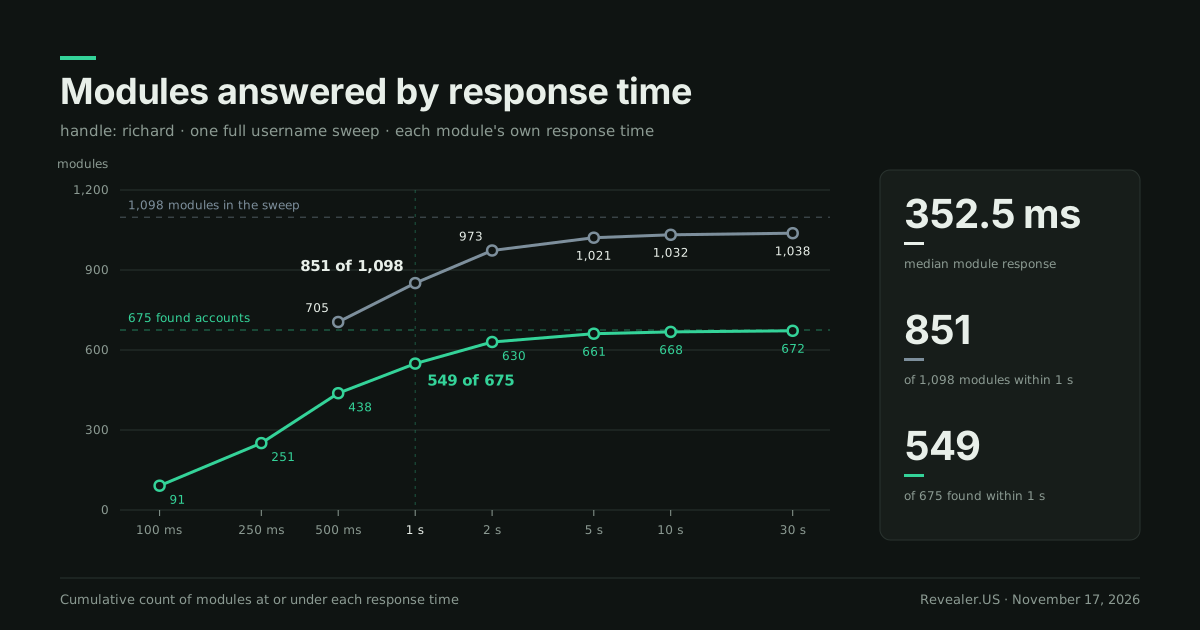
The shape is a steep climb and a long, thin tail. Nearly two thirds of the catalog's modules answered in half a second or less. More than nine in ten found accounts came from modules that answered within two seconds. Seven of the 675 found accounts came from modules that took longer than ten seconds.
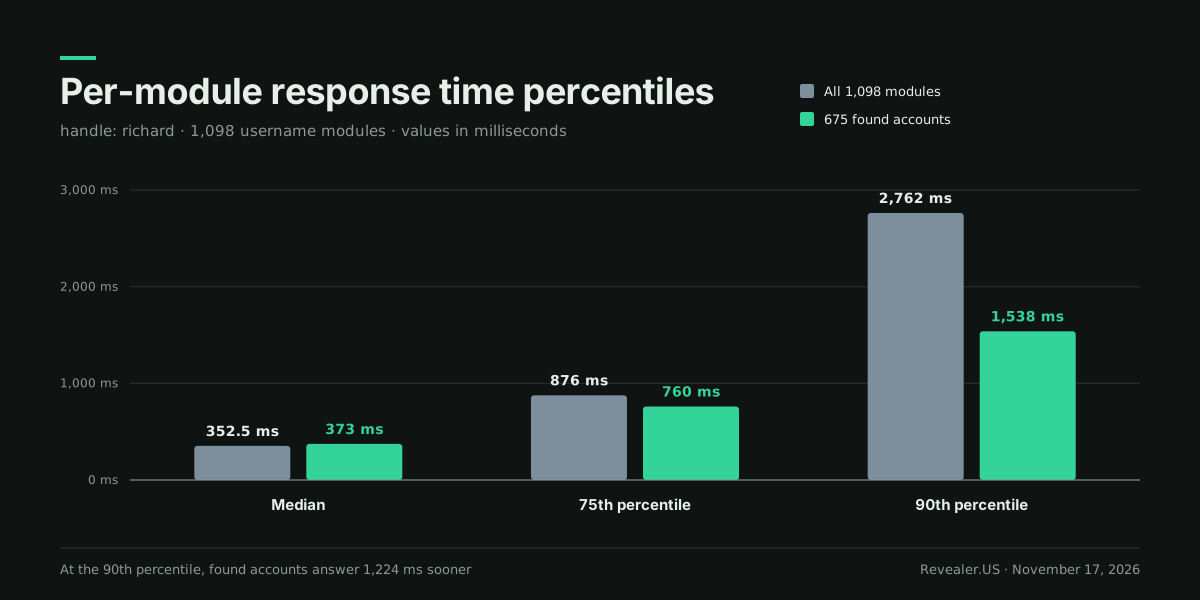
The same data as percentiles:
| Percentile | All 1,098 modules | 968 definite answers | 675 found accounts |
|---|---|---|---|
| Median (50th) | 352.5 ms | 356 ms | 373 ms |
| 75th | 876 ms | 748 ms | 760 ms |
| 90th | 2,762 ms | 1,633 ms | 1,538 ms |
The 95th percentile was 3,000 ms for the 968 definite answers and 2,714 ms for found accounts.
Read the 90th percentile row closely. Across all modules it is 2.76 seconds. Across the modules that found an account it is 1.54 seconds. The answers you came for sit in the fast part of the curve.
Most found accounts come from fast modules
For richard on November 17, 2026:
- 438 of the 675 found accounts came from modules that answered within 500 ms.
- 549 came from modules that answered within 1 second.
- 630 came from modules that answered within 2 seconds.
- 661 came from modules that answered within 5 seconds.
The fastest module that found an account answered in 9 ms. It was the second result delivered in the whole sweep and the first found account.
More than four in five of the accounts the sweep found came from modules that took under a second each, and the slow tail adds the last few. Because results stream, a found account is delivered when its module finishes, not when the whole sweep ends.
What streaming means for a 55-second sweep
A username lookup on Revealer is one request. That request runs the full live username catalog, 1,098 modules on November 17, 2026. You do not pick platforms and you do not page through batches.
Each module's result is delivered as that module finishes. In this run, 1,098 separate results were delivered, one per module, and then a completion record closed the sweep with its total execution time. The per-module times overlap. 247 modules took longer than one second each. Added together, those times are more than the 55.3 seconds the whole sweep reported, so the sweep does not wait for one module before starting the next.
How to read a search in progress:
| While the search runs | What to do with it |
|---|---|
| Found accounts are already listed | Start opening and verifying them while the remaining modules run |
| A platform you care about is not listed yet | Its module may still be running. Wait for the sweep to complete, then check that platform's result |
| The sweep has completed | Export the results as JSON or CSV, or save what you need |
Streaming does not make any single module faster. It means a finished module's result is not held back for the slower ones.
Why an email search takes longer
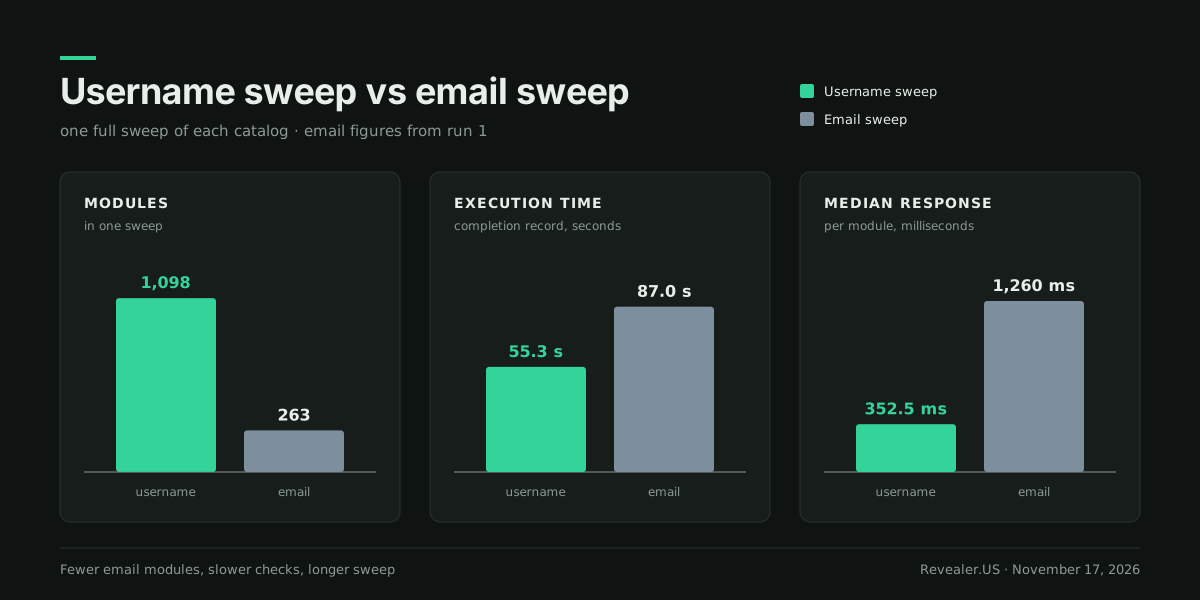
Email lookups run a different catalog with a different timing profile. On November 17, 2026 we captured two full email sweeps. Each covered 263 modules and each reported 87.0 seconds of execution.
| Measure | Username sweep | Email sweep |
|---|---|---|
| Modules in the sweep | 1,098 | 263 |
| Execution time, completion record | 55.3 s | 87.0 s |
| Median per-module response | 352.5 ms | 1.26 s (run 1), 1.31 s (run 2) |
| 90th percentile per-module response | 2,762 ms | 3.57 s (run 1), 3.36 s (run 2) |
| Answered within 1 s | 851 of 1,098 | 98 of 263 (run 1), 96 (run 2) |
| Answered within 5 s | 1,021 of 1,098 | 255 of 263 (run 1), 252 (run 2) |
The reason is per-check cost. An email module's median response was 1.26 seconds against 0.35 seconds for a username module, about 3.6 times as long. Fewer modules, slower checks, longer sweep. Email is still tightly grouped: 255 of 263 modules answered within five seconds in the first run. What those 263 modules check is covered in our email registration check for popular apps.
You can see both shapes without an account in the demo on the Revealer homepage. Its username search shows the results returned inside a 20-second window, and its email search runs the full 263-module sweep. To check your own address, see email lookup.
Do fast results carry profile detail? 591 of 675 did
A fast "this URL exists" is cheap. That is not what these timings describe. Of the 675 found results for richard:
- 591, or 87.6 percent, carried at least one profile field beyond the profile URL.
- 452, or 67.0 percent, carried three or more.
- 512 carried a display name and 279 carried an account creation date.
- 84 were existence-only: a platform name and a URL.
Every found result carries the platform name and the profile URL at minimum. How a hit earns the word "found" is covered in how we verify a username match.
How this compares with our September timing
Until today the only Revealer timing on this blog was in our September 5 three-handle test: one export recorded a sweep time of 30.4 seconds across 813 modules. That was a different handle, a smaller catalog and a single total, with no per-module data. Treat it as a dated reading from September 5, 2026, not as a baseline for today's catalog.
The November 17 run is the current reference. The catalog is 285 modules larger than that September pool. The September export's sweep time and this run's execution time come from different records, so we do not treat the two totals as a like-for-like trend. What the new run adds is the per-module distribution shown above.
The same handle also shows what the added breadth bought. richard returned 488 found accounts from 751 sources on August 26, 2026 in our first richard case study, 547 from 816 on September 3 in the username search benchmark, and 675 from 1,098 on November 17.
Limits of this measurement
One run. One handle, one day. Response times depend on the platforms being checked, so another run on another day can produce different numbers.
Common handle. richard exists on a lot of platforms. A rare handle will return fewer found accounts. The count of modules checked stays the same.
The short version
On November 17, 2026 one full sweep of richard covered 1,098 username modules in 55.3 seconds of execution time. The median module answered in 352.5 ms and 851 answered within one second. Of 675 found accounts, 549 came from modules that answered in under a second, and results stream as each module finishes.
Run your own handle on username search. Free accounts get 10 social previews a day with no card. Paid plans start at $12.99 a month on pricing.
Revealer is not a consumer reporting agency. Its data may not be used for employment, tenant, credit, or insurance eligibility decisions.
Frequently asked questions
How long does a username search take on Revealer?
On November 17, 2026 a full sweep of richard reported 55.3 seconds of execution time for all 1,098 modules. Most modules are far quicker than that total: the median module answered in 352.5 ms and 851 of 1,098 answered within one second. These are module response times and the sweep's reported execution time, not a stopwatch on the dashboard.
Do I have to wait for the whole sweep before I see results? No. Each module's result is delivered as that module finishes, and a completion record closes the sweep. You can start verifying found accounts as they are listed, while the remaining modules run.
Why is an email search slower than a username search? Email modules take longer per check. On November 17, 2026 the median email module answered in 1.26 seconds against 352.5 ms for a username module. A full email sweep covered 263 modules in 87.0 seconds of execution, with 255 of 263 answering within five seconds.
Did adding modules slow the search down? The typical module is quick. We have no per-module timing from before the expansion, so there is no direct before and after. On November 17, 2026 half of the 1,098 modules answered in about a third of a second, and 81.3 percent of found accounts came from modules that answered in under one second. The reported total is larger: a September 5, 2026 export recorded a 30.4 second sweep time for 813 modules on a different handle, and the November 17 run reported 55.3 seconds of execution for 1,098. Those two figures come from different records, so they are not a like-for-like trend.
Can I use these results for background checks? No. Revealer is for checking your own exposure and for lawful investigation. It is not a consumer reporting agency, and results may not be used for employment, tenant, credit or insurance eligibility decisions.